
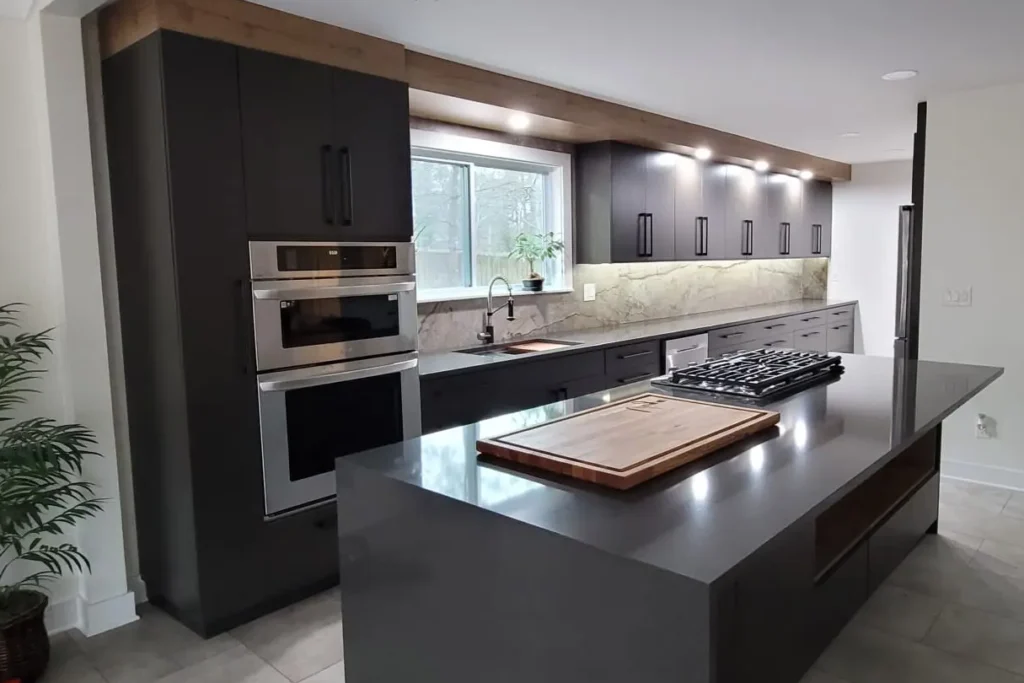
The material used inside a kitchen cabinet matters just as much as its
exterior appearance. It affects structural strength, hardware attachment,
moisture performance and how well the cabinetry withstands everyday use.
Two common materials used for cabinet boxes are plywood and particleboard.
Although both can be covered with attractive finishes, they are manufactured
differently and do not provide the same performance.
At Echos Wood Design, we build our custom cabinet boxes and drawers using
3/4-inch plywood. We do not use particleboard for cabinet boxes.
What Is Plywood?
Plywood is an engineered wood panel made by bonding multiple thin layers
of wood veneer. The grain direction alternates between layers, which helps
create a strong and dimensionally stable panel.
Furniture-grade plywood is frequently used for quality cabinet boxes,
shelves and drawers. Its layered construction provides strength without
adding as much weight as some other wood-based panels.
Exposed plywood edges can be finished with edge banding, solid-wood trim
or decorative finished panels.
What Is Particleboard?
Particleboard is manufactured from small wood particles combined with
adhesive and compressed into sheets. It provides a flat and consistent
surface that can be covered with laminate, melamine or wood veneer.
It is commonly used in mass-produced and budget-oriented cabinetry because
it is generally less expensive than furniture-grade plywood.
Particleboard can function in dry and controlled conditions. However, its
performance depends heavily on panel density, edge protection, hardware
installation and protection from water.
while still containing particleboard in its box, shelves, backs or drawers.
Always ask for written material specifications.
Plywood vs. Particleboard: Quick Comparison
| Feature | Plywood | Particleboard |
|---|---|---|
| Construction | Multiple bonded layers of wood veneer. | Compressed wood particles bonded with adhesive. |
| Structural strength | Strong layered construction suitable for cabinet boxes and drawers. | Performance varies by density and may require more support. |
| Screw holding | Fasteners engage with multiple wood layers. | Overtightening or repeated removal may weaken the attachment point. |
| Moisture exposure | Generally tolerates brief exposure better, but is not waterproof. | Water entering an unsealed edge can cause swelling and deterioration. |
| Weight | Strong without adding excessive weight. | Can be heavy depending on panel density and thickness. |
| Repairability | Damaged hardware attachment points may be easier to repair. | Crumbled or swollen areas can be difficult to restore. |
| Typical cost | Quality cabinet-grade plywood generally costs more. | Usually less expensive and common in budget cabinetry. |
| Common use | Custom boxes, shelves, drawers and structural components. | Mass-produced cabinets and furniture with laminated surfaces. |
Strength and Structural Durability
Plywood generally provides better structural strength for cabinet boxes,
shelves and drawers. The bonded layers help distribute loads and resist
bending during everyday use.
Particleboard can support normal household items when properly designed,
but panel quality varies. Long shelves or heavily loaded areas may require
additional support.
This difference becomes important in kitchens where shelves must support
plates, cookware, food containers and small appliances for many years.
Screw-Holding Ability
Hinges, drawer slides and other cabinet hardware depend on secure attachment
points. Plywood typically holds screws well because the fasteners engage
with multiple layers of wood veneer.
Particleboard can hold correctly installed hardware, especially when the
proper screws and fittings are used. However, overtightening, repeated
removal or installation too close to an edge can damage the material around
the fastener.
Once a particleboard attachment point begins to crumble, repairing it may
be more difficult than repairing a plywood component.
Moisture Resistance
No standard wood-based kitchen cabinet material is completely waterproof.
Prolonged plumbing leaks, standing water and continuing moisture can damage
plywood, particleboard and solid wood.
Quality plywood generally tolerates brief or minor moisture exposure better
than standard particleboard. When water enters an unprotected particleboard
edge, the wood particles can absorb moisture, swell and lose their original
shape.
This is especially important around sinks, dishwashers, plumbing connections
and floors where unnoticed leaks may occur.
can be damaged if a leak is allowed to continue. Water should be removed
and the source of the leak repaired promptly.
Weight and Installation
Cabinet weight varies according to panel thickness, density and construction.
Particleboard can be relatively heavy, while plywood offers a useful
strength-to-weight ratio.
A strong cabinet box that does not add unnecessary weight can be easier to
transport, position and securely install.
Cost and Overall Value
Particleboard is usually less expensive than furniture-grade plywood.
However, actual costs depend on thickness, quality, finish, supplier and
market conditions.
Material price should not be the only consideration. Homeowners should
compare the entire cabinet system, including box construction, shelf
thickness, drawers, hardware, finish, installation and expected use.
A lower initial price does not necessarily provide better long-term value
if the cabinet construction does not match the needs of the home.
Which Material Is Better for Florida Kitchens?
For structural cabinet components in Florida homes, we recommend quality
plywood in most situations.
Florida kitchens may experience humidity, wet floors, plumbing leaks and
heavy everyday use. Plywood is not immune to damage, but its combination
of structural strength, reliable hardware attachment and better tolerance
of occasional moisture makes it a practical choice for cabinet boxes,
shelves and drawers.
Proper installation and quick attention to water leaks remain essential,
regardless of the material selected.
How Echos Wood Design Builds Custom Cabinets
At Echos Wood Design, our custom cabinet boxes and drawers are built with
3/4-inch plywood. We do not use particleboard or MDF for our cabinet boxes.
Our cabinet construction includes:
- 3/4-inch plywood cabinet boxes and drawers.
- Frameless construction for efficient interior storage.
- Full-depth 12-inch wall cabinets.
- Adjustable European-style cabinet legs.
- Removable toe kicks for easier installation and access.
- Soft-close hinges and drawer slides.
- Custom measurements designed for each individual space.
- Local fabrication and professional installation.
Because we design and build our cabinetry locally, homeowners can
understand how their cabinets are constructed instead of making a decision
based only on the appearance of the doors.
What Should You Ask Before Buying Cabinets?
Cabinet descriptions are not always clear. A cabinet advertised as “wood”
may still contain particleboard in the box, shelves, back or drawers.
Before comparing estimates, ask each cabinet provider:
- What material and thickness are used for the cabinet boxes?
- What materials are used for the drawer boxes and bottoms?
- Are the shelves plywood or particleboard?
- How are exposed edges sealed and finished?
- What hinges and drawer slides are included?
- Is professional installation included?
- Are the cabinets custom-built, semi-custom or stock sizes?
These questions make it easier to compare the complete cabinet system
instead of comparing only the door style or total price.
Frequently Asked Questions
Is plywood completely waterproof?
No. Standard cabinet-grade plywood can still be damaged by prolonged
exposure to water. Any plumbing leak should be repaired and dried promptly.
Is every particleboard cabinet low quality?
No. Particleboard quality and cabinet engineering vary. Properly designed
particleboard cabinetry can function in dry conditions, but it does not
provide the same construction characteristics as quality plywood.
Are plywood cabinets more expensive?
Quality plywood cabinetry generally costs more than particleboard
cabinetry. Final project cost also depends on the design, finish,
hardware, accessories and installation.
How can I identify particleboard?
Inspect an unfinished edge, shelf opening or hardware hole.
Particleboard contains visible compressed wood particles, while plywood
shows multiple distinct layers of wood veneer.
Do plywood cabinets still require protection from leaks?
Yes. Plywood should still be protected from standing water and continuing
plumbing leaks. Prompt repairs help prevent damage to the cabinetry and
surrounding areas.
The Final Verdict
Plywood is our preferred material for custom kitchen cabinet boxes because
it provides the structural strength, dependable hardware attachment and
practical durability expected from cabinetry made for daily use.
Particleboard can provide a lower initial price, but it should not
automatically be considered equivalent to plywood. Homeowners should
examine the complete cabinet construction before comparing estimates.
The best decision considers the cabinet boxes, shelves, drawers, hardware,
finish, design and installation—not only the appearance of the doors.
Understanding the differences between plywood vs particleboard kitchen cabinets is essential for making informed choices.